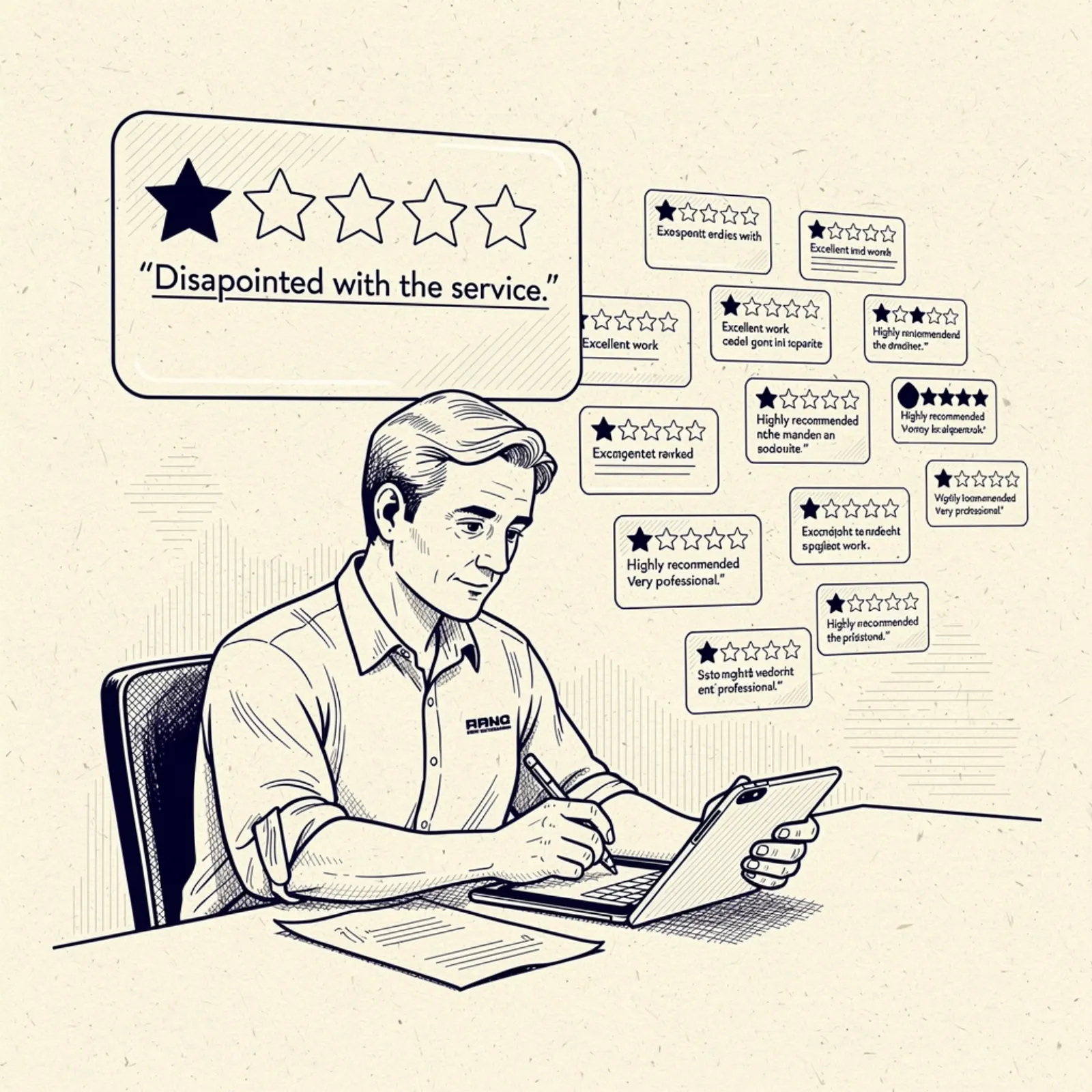
You're going to get a bad review. If you've been in local business long enough and worked for enough customers, someone is going to leave you a 1-star review — sometimes fairly, sometimes unfairly, sometimes for reasons you don't fully understand. Here's how to handle it.
First: don't respond immediately
Your first instinct when you see an unfair bad review is probably to respond immediately and defensively. "This customer was unreasonable." "We went above and beyond." "He didn't tell us about X until we were halfway done." All of that might be true. None of it should be in your public response.
Wait 24 hours before responding. Not because your response won't be seen — it will be. Because the response you write when you're angry is almost always the wrong response. Defensive, justification-heavy responses make you look worse than the original review.
What a good response looks like
Here's the template:
Hi [first name], thank you for taking the time to leave this feedback. We're sorry to hear your experience didn't meet your expectations. This isn't the standard we hold ourselves to at [Business Name]. I'd like to understand what happened and make this right — please reach out to me directly at [phone or email]. [Your name]
That's it. No justification. No "but actually." No explanation of why the customer was wrong. Why?
Because this response isn't really for the person who left the review. It's for the next 1,000 people who read your reviews while deciding whether to hire you. They see a business that responds professionally to criticism, takes responsibility, and offers to fix it. That's a business they can trust. Customers expect bad reviews to exist — they're judging how you handle them.
What never to do
- Never dispute the customer's experience publicly. Even if they're wrong, even if they're lying. You can't win that argument publicly. You'll just look combative.
- Never offer compensation in the public response. "We'll give you a refund if you change your review" is a violation of Google's review policies and makes you look like you're buying ratings.
- Never flag a bad review as "spam" unless it genuinely is. Flagging legitimate negative reviews tells Google your profile manipulates reviews, which can get your GBP penalized.
- Never respond with a wall of text. Keep it under 4 sentences. Every word you add is another chance to say something that makes things worse.
The offline resolution attempt
After your public response, try to reach the customer directly. Call the number on their work order or send them a direct message if possible. Ask what happened from their perspective. Sometimes the issue is a simple miscommunication you can actually resolve. Sometimes they'll update the review if you make it right. Sometimes they're unreachable or uninterested in resolving it.
Make the attempt. Document that you made it. If you resolve it and they update the review, great. If not, you've still demonstrated professional behavior and you've learned something about where your process might have broken down.
Building a review portfolio that makes one bad review irrelevant
The best protection against a bad review is a pile of good ones. A business with 4.9 stars from 6 reviews is devastated by a 1-star. A business with 4.7 stars from 84 reviews barely notices one 1-star — it gets buried and statistically diluted.
The goal isn't a perfect 5.0 — that's actually slightly suspicious to most customers. The goal is a volume of real reviews that tells a story: most customers are happy, the business responds professionally when someone isn't, and the few negative reviews are clearly outliers.
Generate consistent reviews from real customers and handle the occasional bad one with the script above. That's the whole strategy.
Want a site built for your business?
From $199 setup. $49/mo. Live in 3 days. Start with a free mockup.
Get my free mockup